
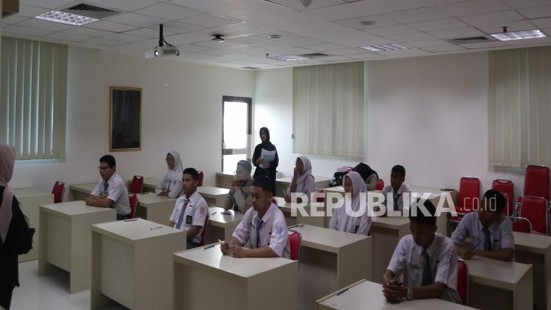
In May 2026, the Faculty of Psychology of Universitas YARSI organized a “Psychometric Testing and Psychological Assessment” program for 51 grade XII students from SMKN 39 Jakarta (32 male and 19 female) as part of Community Service (PkM) funded through Universitas YARSI’s Internal Community Service Grant for the 2025/2026 Fiscal Year. This program was initiated based on critical data from the Central Bureau of Statistics (BPS) showing that the Open Unemployment Rate (TPT) for vocational school graduates reached the highest figure of 9.01 percent, far surpassing high school graduates (7.05 percent) and higher education graduates (5.25 percent), indicating serious problems in the work transition of vocational graduates to the industrial sector. The program organizer, Fitri Arlinkasari, PhD Psychologist (Lecturer at the Faculty of Psychology of YARSI), explained that the main problem does not lie in the technical skills (hard skills) of vocational graduates but rather in the gap in readiness to face formal work selection mechanisms. Data from discussions with school officials showed that the number of SMKN 39 alumni who directly worked was still below ten people per cohort, despite the school having an A accreditation and strong industry partnerships. The main obstacle was that students frequently failed at the initial stage of recruitment because they were unfamiliar with psychometric tests and personality assessments as the first gate in formal company employee selection processes. The program, involving a team of five lecturers, four psychology students as facilitators and testers, and one educational staff member, was specifically designed to close the gap between the technical competencies possessed by students and their readiness to face modern work selection processes.
Universitas YARSI’s psychometric testing program emphasizes the urgency of building comprehensive psychological intervention to enhance career readiness among vocational school students before entering the formal workforce. The activity provides three main benefits for participants: first, realistic simulation that provides direct experience in taking intelligence and career interest tests within time limits according to industry recruitment standards; second, individual feedback in the form of a comprehensive ability profile report along with personalized self-development recommendations; third, clear career direction to help students make objective decisions about working, entrepreneurship, or continuing studies. Assessment results also provide strategic data for SMKN 39 Jakarta to improve learning methods, showing that approximately 75 percent of students have weaknesses in applied numeracy skills requiring contextual numerical training. This program supports the achievement of Sustainable Development Goals (SDGs) Goal 4: Quality Education by improving the relevance of vocational education to workforce needs, Goal 8: Decent Work and Economic Growth through enhanced employability and smoother career transition for vocational graduates, Goal 10: Reduced Inequalities by reducing employment opportunity disparities among graduates of different education levels, and Goal 17: Partnerships for the Goals through strategic collaboration among higher education institutions (Universitas YARSI), vocational schools (SMKN 39), and the industrial sector. Moving forward, Universitas YARSI is committed to expanding partnerships with other vocational schools and the industry, while providing independent training modules for guidance counselors to ensure program sustainability, supported by follow-up evaluation one month after the activity and long-term tracer studies to measure the success rate of participants obtaining their first employment.
