

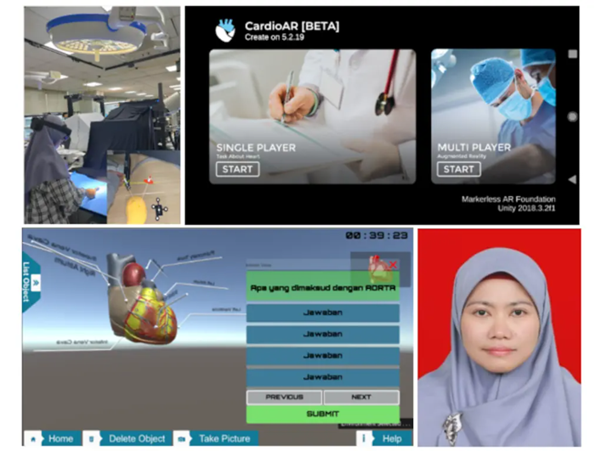
Nova Eka Diana’s professional journey exemplifies the power of interdisciplinary expertise, traversing from computer science to becoming a leading figure in AI-assisted medical technology and digital health measurement. Beginning her academic path at Universitas Indonesia studying algorithms, data structures, and machine logic, Nova sought not merely intelligent machines, but machines that understand humans. Her quest led her to Korea’s KIST School at the University of Science and Technology, where she pursued human-computer interaction and robotics, ultimately completing her doctorate in AI-Robotics in 2025 with excellent graduate distinction. Nova’s research focuses on robust AR-based surgical navigation systems, optical tracking, multi-modal registration integrating CT, MRI, and ultrasound into unified mapping, and 3D reconstruction making internal organs more than flat shadows. Yet her expertise extends beyond surgical technology—she actively researches comparisons between conventional and digital mental health measurement methods, developed emotion classification using machine learning from EEG signals, and created Indonesia’s first modular database on genes and diseases for the Indonesian population. Returning to Indonesia in August 2025, she joined Universitas YARSI as Assistant Professor and leads the Multimedia & Immersive Technology Lab, previously serving as Head of Intelligent Computational Competency Group (2013-2017) and Research Manager (2017-2021). Her diverse innovations include patented ultrasonic calibration phantoms, OTrust software for assessing trustworthy Indonesian-language health information, and applications like Galaw, Ruang Sandar, and Flu Epidemic Detector, demonstrating her commitment to making global technology locally relevant.
Nova Eka Diana’s presence and contributions in Indonesia significantly advance multiple Sustainable Development Goals, particularly SDG 3 on Good Health and Well-being and SDG 9 on Industry, Innovation and Infrastructure. Her development of AR-assisted surgical navigation systems, accurate medical imaging registration, and 3D anatomical reconstruction directly enhances surgical safety, precision, and outcomes, improving healthcare quality and reducing medical errors. By creating digital mental health measurement tools and emotion detection systems, she addresses the critical gap in accessible, scalable mental health assessment—essential for early intervention and treatment in a country where mental health services remain limited. Her work on OTrust combats health misinformation, a major public health threat that undermines disease prevention and treatment adherence. Furthermore, her research supports SDG 4 on Quality Education by developing immersive cardiovascular learning platforms that transform medical education through intuitive visualization. Nova’s establishment of the Multimedia & Immersive Technology Lab at Universitas YARSI creates infrastructure for training the next generation of Indonesian researchers in cutting-edge health technology, building domestic capacity for innovation rather than dependence on foreign solutions. Through her interdisciplinary approach bridging AI, robotics, and healthcare, Nova demonstrates that advanced technology can be wielded with cultural sensitivity and local relevance, ultimately contributing to Indonesia’s journey toward universal health coverage, improved medical education, and technological self-reliance in achieving sustainable development.
