

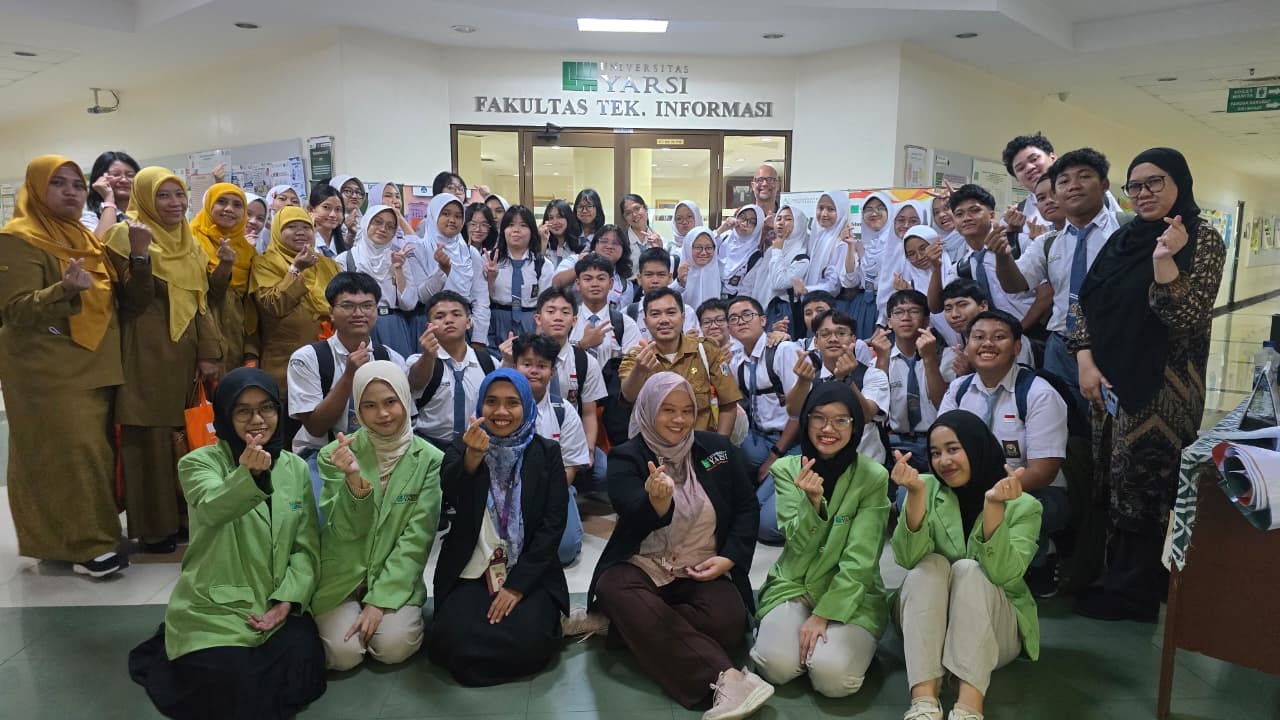
The rapid and widespread adoption of artificial intelligence among students and educators has given rise to a critical concern that can no longer be overlooked the gradual erosion of independent thinking and cognitive capacity. It is precisely this urgency that drove the Faculty of Information Technology (FTI) at Universitas YARSI to host an AI-Based Information Literacy Seminar on April 6, 2026, bringing together students and teachers from SMAN 72 Jakarta. The event featured two prominent experts: Dr. Ummi Azizah Rachmawati, Dean of the Faculty of Information Technology at Universitas YARSI, and Prof. James Swart, Professor of Engineering from Central University of Technology, South Africa. Both speakers underscored a growing danger and that uncritical reliance on AI can lead to what is termed cognitive debt, a long-term decline in critical thinking skills, and even cognitive surrender, where users passively accept AI-generated information without question. Prof. James further highlighted that passive AI use can reduce neural activity by as much as 47 percent and weaken mental engagement in the learning process, signaling that the stakes of AI illiteracy extend well beyond academic performance and into the fundamental development of human cognition.
This seminar directly and substantively aligns with SDG 4: Quality Education, which calls for inclusive, equitable, and quality education that fosters lifelong learning for all. By equipping students and educators with both technical and ethical AI literacy including the practical CIAO (Chandra Interactive Analysis of Observations) framework that guides learners to understand a task, explore AI as an initial tool, formulate responses in their own words, and only then use AI to refine their output the initiative actively promotes the kind of higher-order thinking, creativity, and human agency that quality education demands. Beyond SDG 4, the seminar also resonates with SDG 9: Industry, Innovation, and Infrastructure, by fostering responsible and human-centered innovation in the educational use of emerging technologies, and with SDG 17: Partnerships for the Goals, through its cross-institutional and international collaboration between Universitas YARSI and Central University of Technology, South Africa demonstrating that building AI-resilient generations is a shared global responsibility that transcends borders.
